Showing posts with label UNIT5. Show all posts

Friday

The Use of Articles

English has two articles: the and a/an.
The is used to refer to specific or particular nouns; a/an is used to modify non-specific or non-particular nouns.
 We call the the definite article and a/an the indefinite article.

the = definite article                a/an = indefinite article 

For example, if I say, "Let's read the book," I mean a specific book.
If I say, "Let's read a book," I mean any book rather than a specific book.

Here's another way to explain it: The is used to refer to a specific or particular member of a group. For example, "I just saw the most popular movie of the year." There are many movies, but only one particular movie is the most popular. Therefore, we use the. 

"A/an" is used to refer to a non-specific or non-particular member of the group. For example, "I would like to go see a movie." Here, we're not talking about a specific movie. We're talking about any movie. There are many movies, and I want to see any movie. I don't have a specific one in mind.

Let's take a closer look at the use of the articles in English.


General rules:

  1.  a/an before singular countable nouns mentioned for the first time
  2. a/an before some expressions of quantity
  3.  the before proper nouns (eg rivers and mountain ranges)
  4.  the before superlative adjectives
  5.  the before singular countable nouns when we have a specific thing in mind
  6. no article before countries, languages, cities, etc
  7. no article before people or things in general


Ex 1         Ex 2


Be Used To & Get Used To


Tuesday

Gerunds and Infinitives

There is no quick and easy way to learn gerunds and infinitives. It takes years of practice and familiarity with the English language. Sorry about that! Over time, you will begin to use the right verb combination.

           Basically, some verbs are followed by gerunds, some verbs are followed by infinitives, and some verbs can be followed by gerunds or infinitives. Native speakers do not think about the difference. But English learners have to memorize the hundreds of different verb combinations. Here are a few tips.


Tip Number 1: you almost always find a gerund after a preposition. For example, “She is afraid of flying.” In this sentence “of” is the preposition and “flying” is the gerund. You cannot say “She is afraid of to fly.” An infinitive cannot be the object of a preposition, only a gerund can. You could say, “She is afraid to fly,” but in this sentence, the preposition “of” is gone.
Tip Number 2: When you are talking about an activity, you usually use a gerund. For example, “I stopped smoking.” You can describe many activities by using “go” before a gerund. “Let’s go shopping,” or “We went skiing.”
This is only a simple introduction to a complicated grammar topic. Take a look at the lists here and here.   

Let's see how much you know already.   Exercises

Monday

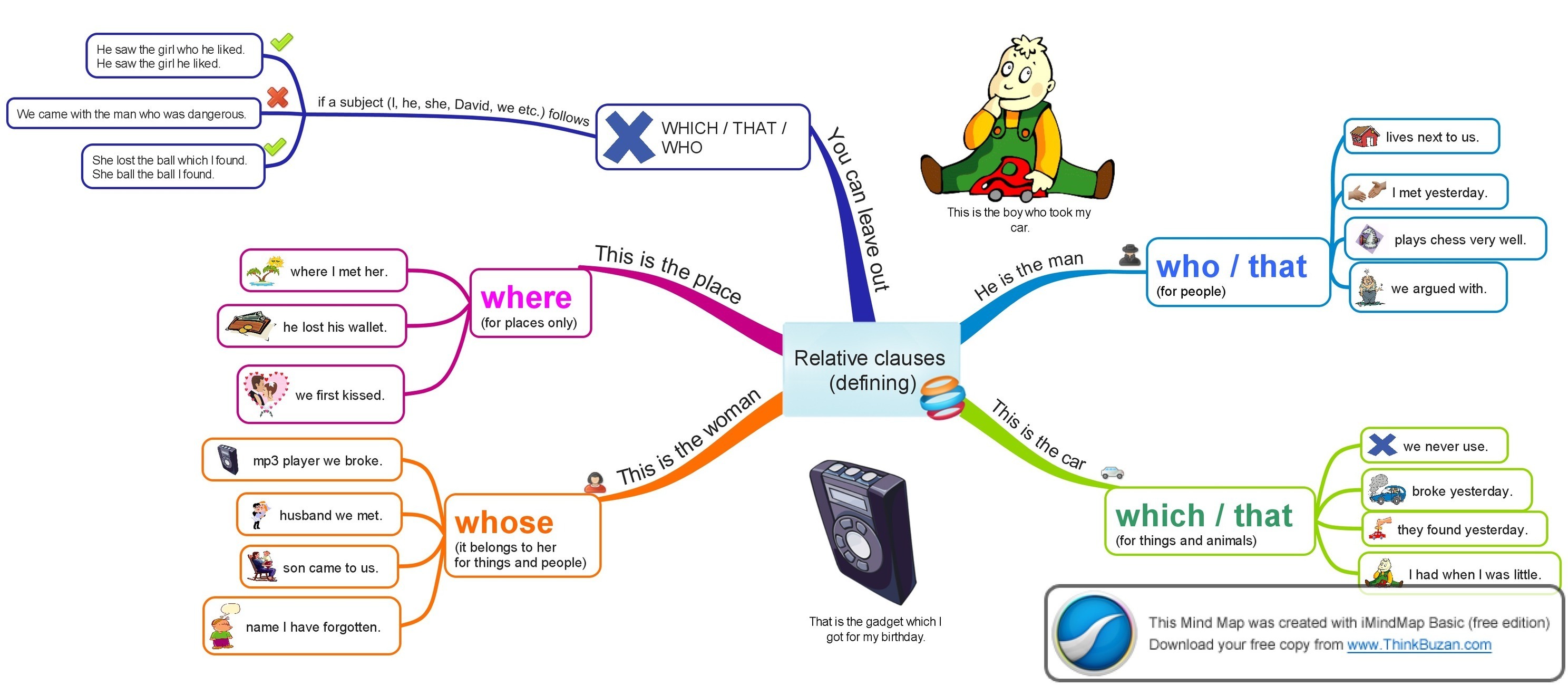
Relative Clauses

Relative sentences are sentences which work as adjectives and sometimes can be replaced with one of them. Like the adjectives, sometimes they define the noun they go with (A), and sometimes they only give additional information about it (B).
Ex: (A) The books which are interesting are best sellers. The interesting books are bestsellers. (Los libros que son interesantes son bestsellers. Los libros interesantes son bestsellers)
Ex: (B) Shakespeare, who was born in Stratford, wrote Hamlet. (Skakespeare, que nació en Stratford, escribió Hamlet)

We use relative clauses to give additional information about something without starting another sentence. By combining sentences with a relative clause, your text becomes more fluent and you can avoid repeating certain words.

The information they give can be necessary or additional and this separates the sentences into two types too:

A.- Defining relative clauses: those which give information absolutely necessary to define the noun and recognize it. Ex: The man who lives next door is a doctor. (El hombre que vive al lado es médico.)

B.- Non-defining relative clauses: those which give information that can be interesting or new but never necessary to define the noun, that’s why we place them between commas. Ex: My sister Mary, who studied law, works in New York. (Mi hermana Mary, que estudió derecho, trabaja en Nueva York).

The relative clause is placed just after the noun it modifies.
Ex: My brother, who works as a doctor, studied in Salamanca. ( non-defining) The boy who lives next door is a doctor ( defining)


Defining and Non-defining

defining relative clause tells which noun we are talking about:
  • I know the woman who lives next door.
    (If I don't say 'who lives next door', then we don't know which woman I mean).
non-defining relative clause gives us extra information about something. We don't need this information to understand the sentence.
  • I live in London, which has some fantastic parks.
    (Everybody knows where London is, so 'which has some fantastic parks' is extra information).
Click on the image

Click on the image


Click on the image


Perfect English Grammar: What is a relative clause?