Showing posts with label UNIT6. Show all posts

Monday

2º Bach Comparatives Unit 6


COMPARATIVES AND SUPERLATIVES

  1. We use more.... for adverbs that end in -lymore slowly, more quietly
  2. You can use -er or more... with some two-syllable adjectives, especially: quiet, clever, narrow, shallow, simple
  3. IRREGULAR COMPARATIVES:  good/well  >  better, bad/badly > worse, far > further/farther
  4. FURTHER & FURTHEST meaning 'more' or 'additional': Let me know if you hear any further news
  5. Before comparatives, you can use QUANTIFIERS such as:  much, a lot, far, a bit, a little, slightly (He's much / slightly taller than his sister). Other forms to quantify the comparison are: far less, far more, much less, much more.
  6. You can use any, no + adjective in the comparative form. Ex. I'm not waiting any longer.
  7. Two comparatives of superiority connected by and meaning 'CADA VEZ MÁS'. Ex. The situation is becoming harder and harder.
  8. 'CUÁNTO MÁS..., MÁS...'  >>>   The sooner, the better.
  9. Difference between 'older' and 'elder'  //  'oldest' and 'eldest' (remember: an elderly lady).
  10. COMPARATIVE OF EQUALITY: so, as....as....    Fernando Alonso is as fast as the wind.
  11. COMPARATIVE OF INFERIORITY: less....than...    My cousin is less intelligent than my sister.
  12. Difference between LESS & FEWER.   Examples: I've got less money than you. A bicycle has got fewer wheels than a bus.
  13. Some interesting collocations: the same as, different from, similar to   
  14. We use the most.... to form the superlative form of adverbs that end in -ly or longer adjectivesthe most slowly, the most quietly, the most intelligent
  15. You can use the expression by far to emphasize the superlative: He is the best tennis player by far!
  16. After superlatives we use in with places (the longest river in the world) and of for a period of time (the happiest day of my life)
  17. ABSOLUTE SUPERLATIVE meaning 'very'. The book you lent me was most interesting.


2º Bach Unit 6 Passive Voice


Passive Activities and Charts


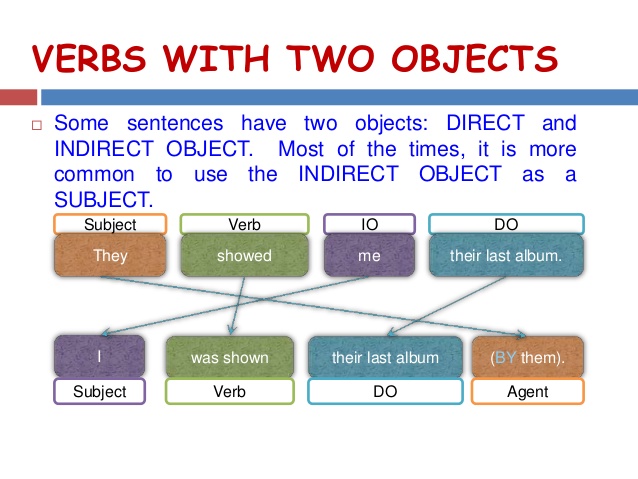
Two objects in an active sentence – two possible passive sentences

When there are two objects in an active sentence, there are two possible active sentences and two possible passive sentences.
  • Sentence 1: The professor gave the students the books.
  • Sentence 2: The professor gave the books to the students.
There are two objects in each of the following sentences:
  • Object 1 = indirect object → the students
  • Object 2 = direct object → the books
An indirect object is very often a person, a direct object a thing. When a direct object is followed by an indirect one, we put to in front of the indirect object.

Active sentence 1

SubjectVerbindirect Objectdirect Object
The professorgavethe studentsthe books.

Active sentence 2

SubjectVerbdirect Objectindirect Object with to
The professorgavethe booksto the students.

Each of the objects (books/students) in the active sentences can become subject in the passive sentence.

Passive sentence 1

SubjectVerbObject(by-agent)
The studentswere giventhe books.(by the professor).

Passive sentence 2

SubjectVerbObject(by-agent)
The bookswere givento the students(by the professor).

Ex 1      Ex 2     Ex 3

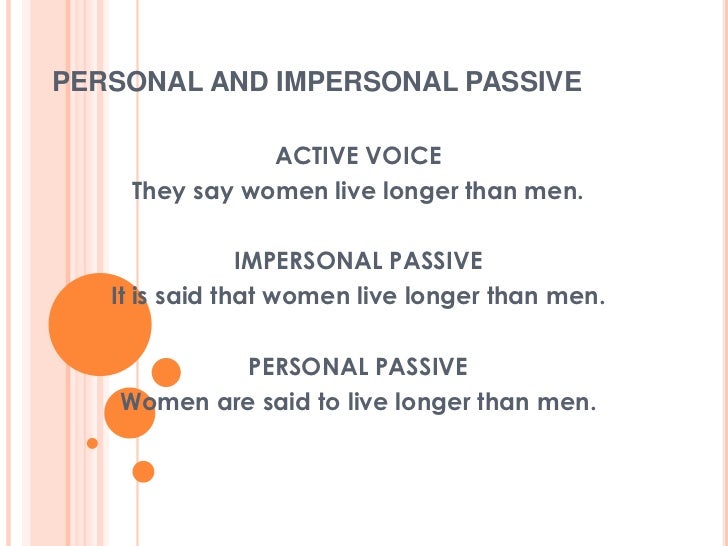
Causative & Impersonal Passive


1º Bach Unit 6 Grammar & Vocabulary

You have learned some verbs related to crime in unit 6. Test your knowledge with this interactive exercise. Click at the top right-hand corner to enlarge the window.

Link to the Passive Voice


Have Something Done / Causative Passive en español


Exercise 1. Quiz.    Exercise 2. Online quiz.

Exercise 3. Choose the right answer.   Exercise 4. Complete

Exercise 5. Rewrite the sentence.    Exercise 6. Follow the example 1.

Exercise 7. Follow the example 2.   Exercise. Let / Make / Have / Get

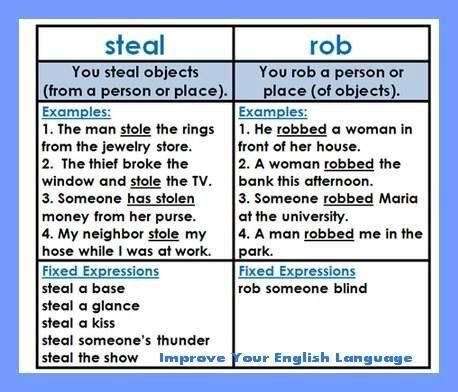
Steal vs Rob


Sunday

Compound Nouns


Words can be combined to form compound nouns. These are very common, and new combinations are invented almost daily. 


They normally have two parts. 
The first part tells us what kind of object or person it is, or what its purpose is.
The second part identifies the object or person in question.
You may have noticed that the compound noun can be written either as a single word (toothpaste), as a word with a hyphen (ccoking-oil), or as two words (paper clip). There are no clear rules about this. A good rule of thumb is to write the most common compound nouns as one word, and the others as two words.

The rules on whether to put a hyphen, a space, or nothing between the words in a compound noun are inconsistent. For example:
  • inkwell , ink well , ink-well 
  • fulltime , full time , full-time 
  • waterbottle , water bottle , water-bottle 
It is best to use a spellchecker or a dictionary to see what versions of the word are acceptable. 

Noun Suffixes

Noun Suffixes 

Suffixes are affixes that attach to the ends of the base forms of words to create new words or new forms of words. Suffixation is a type of English derivation that creates new words. In addition to the agent suffixes -er, -or, and -ar, other derivational suffixes also result in the creation of agent nouns. Derivation suffixes create new agent nouns, nouns that identify the person performing an action or, in other words, names for people.


The following suffixes are more noun suffixes that create names for people:
 -ist – person
 -ian – of or belonging to
 -ess – denoting female persons
 -ar /-er/-eur/-ier/-or/-ur – agent

For example, affixing -ist to the base form of the noun art results in the new noun artist, meaning someone who creates art, and affixing -ian to the base form of the noun library results in the new noun librarian, meaning someone who works in a library.